
Battery for cottage with 12V electricity
The starting point: a detached cottage with mainly only electronics and a 12V fridge when on site. When not present, the battery is switched off. Remote monitoring and inverters are not considered necessary here.
The yield from solar panels is not taken into account, due to the fact that it is not available at all in all circumstances. Naturally, during the summer, the panels provide most, if not all, of the energy needed. As the cottage is used in all seasons, it is useful to have an aggregate and a charger on site to charge the battery when needed.
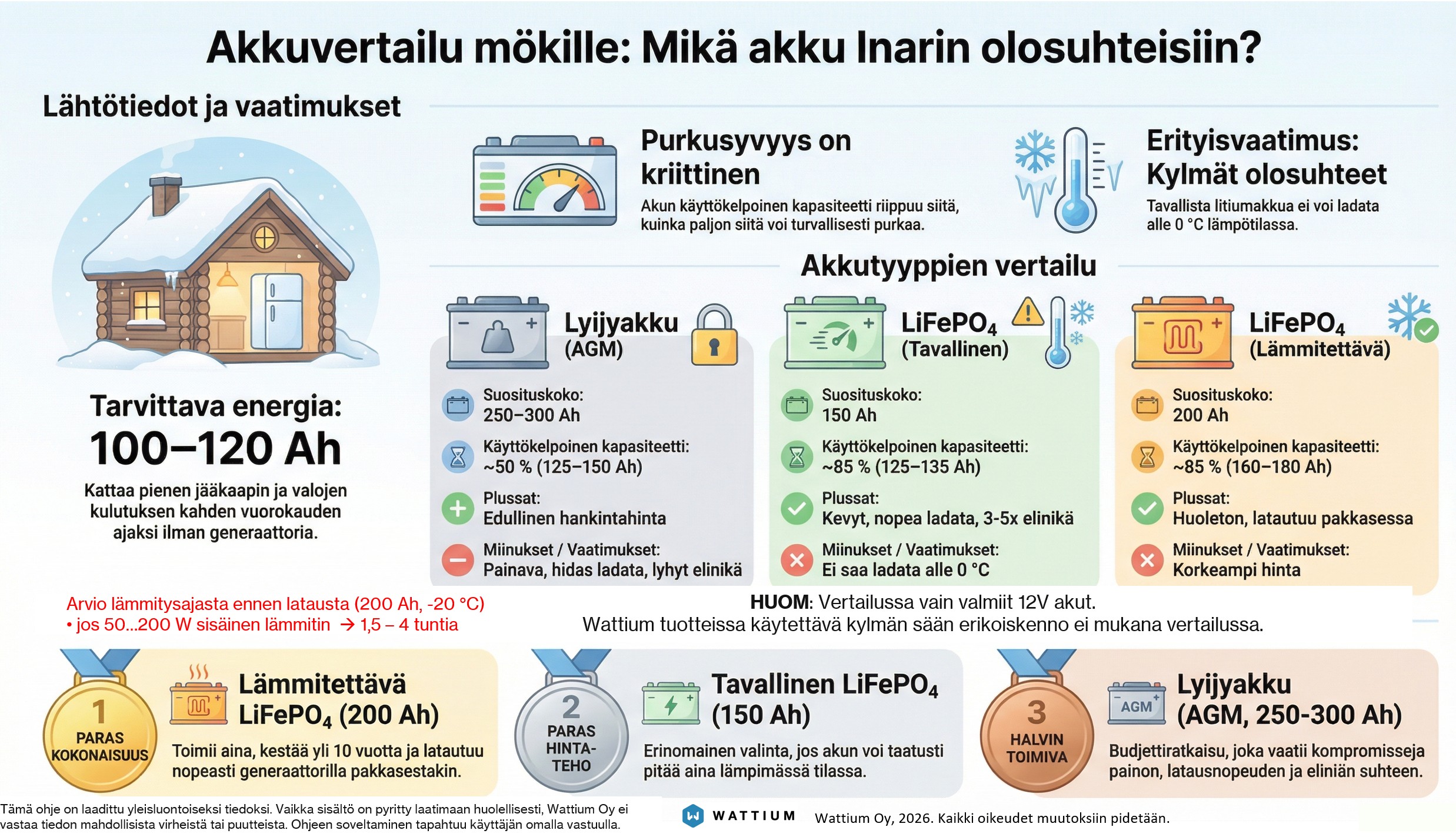
The infographic summarises the main features of a small battery for winter conditions.
Click on the image – opens larger
For more information, visit
Heatable Lithium battery
The time needed to heat lithium batteries is an estimate. When heating the battery, it must be taken into account that the internal parts of the battery also reach a sufficient temperature.
For example, there is a Sunwind 300Ah battery for which the manufacturer states a heating time of 45 min when the initial temperature is -15C. Often this information is not available. Not even the power ratings of the heating resistor.
Heating a lithium battery indoors
For example, if the battery is in a living space and the space is heated on arrival or with a remote heater – batteries can take a very long time to warm up. This is because the heat flux transferred to the battery is dependent on the room air temperature, which increases relatively slowly. Heat from the outside of the battery must also be transferred to the core of the battery.
If the battery is encased in a plastic or metal case that does not provide very good heat conduction to the cells, it can take up to several days for a large battery to warm up.
Charge produced by panels at temperatures below 0C
When the battery is below 0C, the battery protection circuits may prevent charging until the battery is warm. This can cause a nasty surprise when the energy from the panels does not build up the battery’s charge.
Lead-acid battery backup with aggregate
For a lead-acid battery, it is worth noting that it can take a very long time for the battery to reach full charge when charging with an aggregate. Often chargers enter a so-called float state when the battery is about 80% charged, after which charging slows down dramatically. This is why often the actual usable capacity of the battery can be lower than expected – if the battery is not fully charged.
| Step | New battery | Softened battery |
|---|---|---|
| Bulk | 1-3 h | 10-40 min |
| Absorption | 2-6 h | 0.5-2 h |
| Float | maintenance | does not fill the battery |
| Equalisation | 1-2 h | 1-3 h |
Examples of batteries
It will be possible to list proven models here later.
If something was left wondering
👉 Contact us using the form on the front page and get a clear answer.